Chorthippus biguttulus - Bow-winged Grasshopper
Ramme, 1942
Description: Small species (♂ 13-16 mm, ♀ 16-21 mm). Ground colour brown, sometimes green, the tip of the male's abdomen is often yellow or red. The side keels of the pronotum are angularly curved. Fore wing 1-3 mm longer than hind knee, transparent, with Chorthippus lobe. Hind femur and knee are more or less uniformly coloured. Tympanum is slit-like (3.6-6 x longer than wide).
Similar species: The Ch. biguttulus-group (Ch. biguttulus, Ch. mollis, Ch. brunneus), these species are very similar to each other. Best identification is by listening to the male's calling song.
Adults: from June to November
Song: Sings in sunny weather. The sound is strong and easily recognisable, resembling a rapidly shaken rattle. Similar to the song of Gomphocerippus rufus , but deeper and with slightly shorter chirps. The song consists of 2-3 parts, each increasing in volume from beginning to the end. The first part is the longest (2-6 seconds), the following ones are shorter (about 2 seconds), with intervals of 1 to 2 sec.
Source: Orthoptera Species File (lab recording, 25 °C)
Habitat: Meadows, forest edges, roadsides. Mostly in dry and open habitats. A moderately good flier.
Distribution: Widespread and very common, especially in hills.

Chorthippus biguttulus, male
(Author: Szlovik Márton, source: ízeltlábúak.hu, CC BY 4.0)
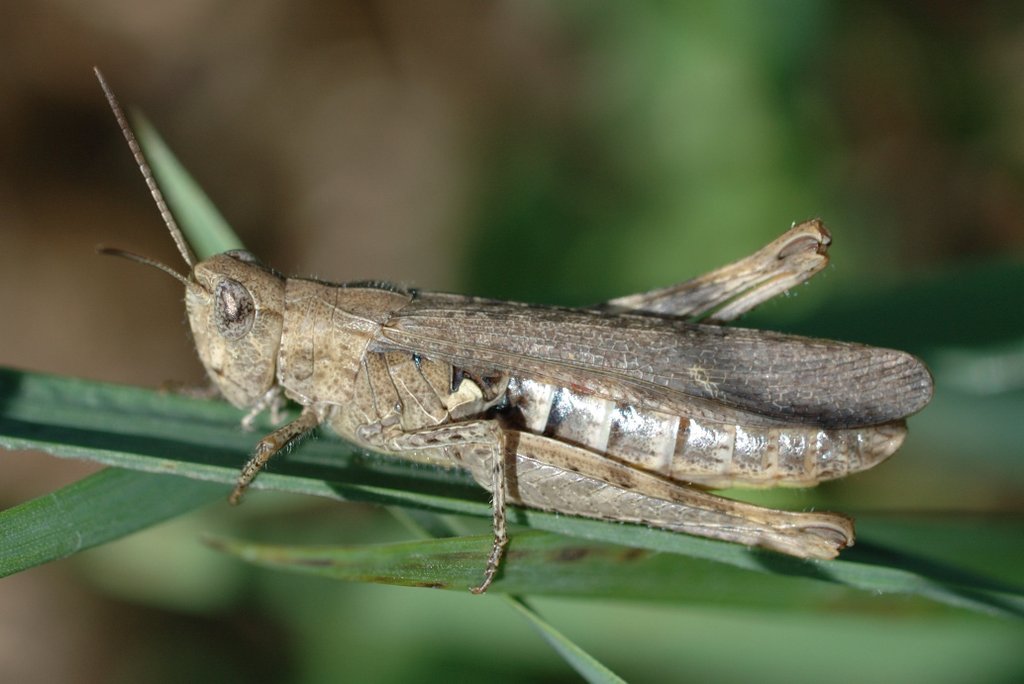
Chorthippus biguttulus, female
(Author: Dobos Zsolt)